Monday, August 29, 2005
Behavioural Finance and Business Valuation: Course Outline
Uploaded the outline for my course on Behavioural Finance and Business Valuation. It can be downloaded from here.
Thursday, August 04, 2005
A nine-year old dreams up a M&A Deal


Last night, over dinner, I was telling my family about Adidas' plans to buy Reebok.
Gauri, my younger daughter who is nine years old thought about what I had said and then blurted:
"I think Subway should buy Big Chill (her favourite restaurant in Khan Market, New Delhi)".
Highly amused, I asked Gauri, "Tell me three reasons why Subway and Big Chill should merge."
Gauri is highly familiar with the term "merge" because when we play Monopoly, two players often merge when they find synergies (complimentary properties, cash and properties combo etc.)
Its extremely fascinating to discuss stuff like this over the dinner table with kiddos.
Gauri thought about my question for a while and then giggled, in substance, the following reasons:
- Subway Sandwich outlets have awesome smell and if Subway merges with Big Chill, then more customers will come to eat in the merged entity;
- Big Chill makes the best desserts in the world and Subway makes the best sandwiches in the world, and therefore, if the best of both are offered under the same roof, the revenues of the combined entity will be more than the revenues of the two outlets on a stand-alone basis; and
- People who can't eat subway sandwiches (like Gauri's elder sister Garima, because she got braces installed recently) can eat the Big Chill food, while other members of the family freak out over both. So, there will be more reasons for such families to visit the combined entity.
Not bad at all!
Keep it up Gauri, you've all the hallmarks of becoming a fundoo M&A player...


Wednesday, August 03, 2005
When the promoter goes to jail, the projections go out of the window
In June 2005, Provogue came out with an IPO priced at Rs 150 per share. The IPO was subscribed 67 times (social proof, deprival super-reaction) the number of shares offered. The stock opened for trading at Rs 250 and closed at Rs 205 on 2 August.
At Rs 205, the company's market cap comes to Rs 331 cr. Add debt of Rs 33 cr. and the enterprise value comes to Rs 364 cr. Is this valuation justified by the current fundamentals (the future will be hazy now, isnt it?)?
For FY 2004-05, the company reported revenues of Rs 115 cr., EBITDA of Rs 14 cr., and PAT of Rs 7.2 cr. So, the current enterprise value of Rs 364 cr. is 3.2 times revenues and 26 times EBITDA. The P/E comes to 46 times. Nifty's P/E is 14.58 times.
Sadly, the stock is not traded on futures and options. Sigh...
One interesting aspect of the IPO is the innovative application of Mr. Munger's "backward thinking" wherein the seller of shares approaches the intermediaries and tells them "I want Rs xyz per share, for selling z% of my company and now its up to you to justify this valuation by making projections about the future of my company." And so, given the nature of competition in the intermediateries market, there are strong incentives to apply backward thinking by taking the price being asked as correct, and working backward to figure out what the future of the company should be (on paper, of course), to justify that price.
When the promoter goes to jail, the projections go out of the window. Remember MS Shoes' Pavan Sachdeva and Mesco's Rita Singh? Where are their companies?
How can it be otherwise?
After all, pavlovian association works both ways. Fardeen Khan, who endorses the company's brand, and popular retail chains like Shoppers' Stop, Westside, Pyramyd, Pantaloon, and Lifestyle who sell Provogue apparel, will be doing some very serious thinking.
It will be interesting to watch what the insiders do with their stock.
Models:
Social Proof
Deprival Super Reaction
Incentives
Pavlovian Association
Mental Trick:
Backward Thinking
At Rs 205, the company's market cap comes to Rs 331 cr. Add debt of Rs 33 cr. and the enterprise value comes to Rs 364 cr. Is this valuation justified by the current fundamentals (the future will be hazy now, isnt it?)?
For FY 2004-05, the company reported revenues of Rs 115 cr., EBITDA of Rs 14 cr., and PAT of Rs 7.2 cr. So, the current enterprise value of Rs 364 cr. is 3.2 times revenues and 26 times EBITDA. The P/E comes to 46 times. Nifty's P/E is 14.58 times.
Sadly, the stock is not traded on futures and options. Sigh...
One interesting aspect of the IPO is the innovative application of Mr. Munger's "backward thinking" wherein the seller of shares approaches the intermediaries and tells them "I want Rs xyz per share, for selling z% of my company and now its up to you to justify this valuation by making projections about the future of my company." And so, given the nature of competition in the intermediateries market, there are strong incentives to apply backward thinking by taking the price being asked as correct, and working backward to figure out what the future of the company should be (on paper, of course), to justify that price.
When the promoter goes to jail, the projections go out of the window. Remember MS Shoes' Pavan Sachdeva and Mesco's Rita Singh? Where are their companies?
How can it be otherwise?
After all, pavlovian association works both ways. Fardeen Khan, who endorses the company's brand, and popular retail chains like Shoppers' Stop, Westside, Pyramyd, Pantaloon, and Lifestyle who sell Provogue apparel, will be doing some very serious thinking.
It will be interesting to watch what the insiders do with their stock.
Models:
Social Proof
Deprival Super Reaction
Incentives
Pavlovian Association
Mental Trick:
Backward Thinking
Monday, August 01, 2005
Here's looking at you kid!
Why should a 40-year old finance professor cum investment professional draw inspiration from an undergrad finance student roughly half his age?
Well, why not?
Shai Dardashti is 21 years old and is doing a wonderful job on his new blog.
All Grahamites should bookmark Shai's blog.
Drawing inspiration from Shai, I will be a bit more active on my blog now!
Well, why not?
Shai Dardashti is 21 years old and is doing a wonderful job on his new blog.
All Grahamites should bookmark Shai's blog.
Drawing inspiration from Shai, I will be a bit more active on my blog now!
Sunday, July 31, 2005
These are a few of my favourite things (from amazon.com)
Since 1997, I have purchased 433 books, dvds, audio cds and other stuff from amazon.com, with books constituting more than 80% of the total purchases. Of the books I have bought and read, I found some of them worth recommending to others. These books are listed in four lists on amazon.com:
- Great books on finance and investment;
- Other books on finance I loved reading;
- Biographies/Autobiographies I loved reading; and
- Books which helped me in multi-disciplinary thinking.
I also plan to make a list of my favourite films, which I shall post here shortly.
Saturday, July 30, 2005
Reflections on Indian Stock Market Levels
"Stocks are high, they look high, but they're not as high as they look."
So said Warren Buffett several decades ago to his investment partners. At that time, the US stock market was ruling at an all-time high and Buffett's partners were worried about investing more money and/or remaining invested in the market. Buffett reasoned that its foolish to focus on absolute stock prices and absolute levels of stock market indices.
I'd say that the same logic applies today, here, in India. Yesterday, Nifty closed at 2,312, an all time high as the chart below shows:
The above chart confirms the conclusions drawn earlier. The current Price/Dividend ratio of 61.73 is way below peaks reached in earlier bull markets.
So, my net conclusion is this: Given recent performance of the corporate sector, and given the sustainability of this performance, the current level of interest rates, the Indian stock market is not expensive.
In other words, "Stocks are high, they look high, but they're not as high as they look."
Sanjay Bakshi
http://www.sanjbak.com/
So said Warren Buffett several decades ago to his investment partners. At that time, the US stock market was ruling at an all-time high and Buffett's partners were worried about investing more money and/or remaining invested in the market. Buffett reasoned that its foolish to focus on absolute stock prices and absolute levels of stock market indices.
I'd say that the same logic applies today, here, in India. Yesterday, Nifty closed at 2,312, an all time high as the chart below shows:
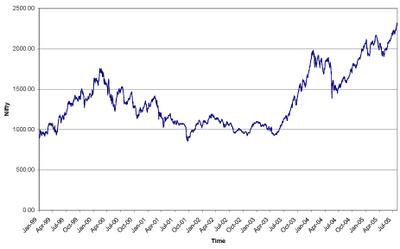
But how high is Nifty really? Put another way, does "all time high" mean "expensive?"
To answer that question, I'd use a few different charts. Unlike the charts used by technical analysts, who look for trends, necklines and hemlines, heads and shoulders, penetration of tops and violation of lows, and the shapes of bottoms and other parts of the female anatomy they "see", my charts focus on one variable that, while not so interesting to the sexually minded chartist, is extremely useful to the buyer of values. That variable is relative value over time. Its foolish to think of stock prices as high or low in absolute terms. Just like a cow is bought for her milk, stocks are (or should be) bought for the underlying earnings of the businesses to which they belong.
The chart below looks at the movement of the Price/Earnings ratio of Nifty over time. In other words it measures how many rupees has the market been willing to pay for ever rupee of corporate earnings in Nifty. 
The above chart clearly shows that even though the stock market may be quoting at an all time high, the market value of every one rupee of corporate earning power is nowhere near its all time high. Indeed, at its current value of 14.69, Nifty's P/E multiple is 33% less than the P/E multiple of 22.01 in March 2004 and 48% less than the peak P/E multiple of 28.29 in March 2000.
Now, take a look at another chart in which I have plotted both Nifty as well as its P/E multiple over time. 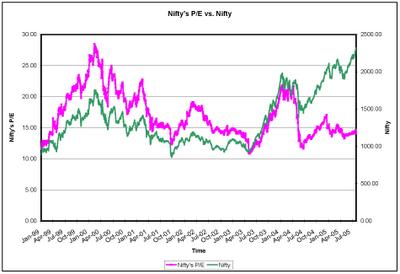
The green series reflects the Nifty and the pink one reflects Nifty's P/E multiple over time. The chart shows that even though stock prices have risen, P/E multiple has declined. Moreover the gap between the green line (Nifty) and the pink line (Nifty's P/E) has never been as wide as it is at present. How did this happen? The answer is quite obvious. Corporate earnings have grown far more rapidly than stock values and a result the market is now paying a lower amount for every rupee of earning power as compared to what it was willing to pay in the past. This can mean two things. Either the earnings growth has to decline in the next few quarters or stock prices have further room to rise.
Given the current strength of the economy, the chances for growth in volume of sales and profits, appears to me to be very good. This is not an expensive market to invest in. Indeed, given the likely scope of future earning power growth and low interest rates it can easily be argued that a significantly higher P/E multiple for Nifty is warranted. Morover, deep value stocks of fast growing companies available for acquisition can be bought today at P/E multiples which are typically less than half of Nifty's P/E multiple of 14.69.
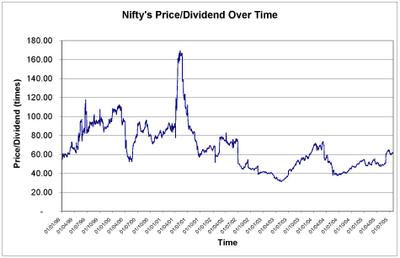
Here's another chart that plots Price/Dividend ratio of Nifty over time. Price/Dividend ratio is the reverse of dividend yield. I like P/D because it is a subset of P/E and its often more useful to invert a much-used ratio.
The above chart confirms the conclusions drawn earlier. The current Price/Dividend ratio of 61.73 is way below peaks reached in earlier bull markets.
So, my net conclusion is this: Given recent performance of the corporate sector, and given the sustainability of this performance, the current level of interest rates, the Indian stock market is not expensive.
In other words, "Stocks are high, they look high, but they're not as high as they look."
Sanjay Bakshi
http://www.sanjbak.com/
Monday, July 11, 2005
On the Seven Deadly Sins, CAPM, and Circle of Competence
Much of the views expressed in this piece have been framed after extensive reading of the transcripts of various talks given by Mr. Charlie Munger, vice-chairman of Berkshire Hathaway Inc., and other material. I am grateful to Outstanding Investor Digest, Futile France, and of course, Mr. Munger himself, for making much of these materials available to me.
A few months ago, I gave a talk to my students at MDI on Capital Asset Pricing Model (CAPM) and the insanities that arise from that model. Here I summarise some portions of that talk, using Mr. Munger's approach to thinking - the multidisciplinary approach.
What have the seven deadly sins, or rather one of the seven deadly sins, got to do with CAPM? According to Mr. Munger, lots. Let us look at the seven deadly sins from a value investor's viewpoint ;) In other words, we'll examine the upside-downside ratio of each of the seven deadly sins.
Of the seven deadly sins - Pride, Gluttony, Lust, Anger, Greed, Sloth, and Envy - there is only one sin which has no upside associated with it. Which one? Pride? No. An excessively proud person does get some kick out of his behaviour. Same with gluttony. A glutton may become sick after his gluttonous behaviour, but at the moment of eating, he is really liking it. Lust? Of course not - no explanations needed here! Anger? No again. Everyone knows how nice it feels occasionally to vent one's anger. Greed? No again, as Gekko put it "greed is good" and often it is. Sloth? Nyet - every couch potato knows and experiences the upside of sloth. So, using backward thinking ;) we're left with the last sin on the list - the deadliest of the seven deadly sins - ENVY.
Envy is the only sin out of the seven deadly sins that gives no upside at all - no kick at all - to its practitioner. The envious people in the world are miserable people because there is only downside risk, and no upside reward in being envious. Looked from an investor's viewpoint, the lesson is simple: if you want to conquer the seven deadly sins, the first one to conquer is envy. And, maybe, the only one to conquer is envy. ;)
Now, what has all this to do with CAPM and circle of competence? Lots, according to Mr. Munger. Lets see how.
CAPM tells us how to allocate capital. The simple idea behind CAPM is that projects that are expected to earn a return on capital which exceeds the cost of capital should be accepted i.e. capital should be allocated towards them. Conversely, projects that are expected to earn a return which is less than the cost of capital, must be rejected.
So far, so good. The idea that projects which earn more than their cost of capital should be accepted, and vice versa, is a good idea. Indeed, it is derived from Mr. Munger's mental model from microeconomics - Opportunity Cost.
And since CAPM is a widely-accepted model of capital allocation around the world, which projects get capital allocated to them, and which don't, depends to a large degree on how the cost of capital is calculated. Two questions arise here:
- What if CAPM miscalculates cost of capital?
- What happens to projects that promise to deliver high real returns which are still less than the cost of capital (mis)calculated using CAPM?
The first question pertains to the appropriateness of using CAPM to calculate cost of capital. And, both Mr. Munger and Mr. Buffett, have, for years, been trying to demolish the idea that CAPM is a good model for estimating opportunity cost. The reason they provide is that CAPM estimates cost of equity capital by using beta as the proxy for risk and beta, in their view, has nothing to do with risk - a term they define as the probability of permanent long-term capital loss. Their views on this subject are well known (for example see section titled "Common Stock Investments" in Mr. Buffett's 1993 letter to BRK shareholders) , and, therefore, I would like to move on to the second question in the above list.
The second question is this:
What happens to projects that promise to deliver high real returns which are still less than the cost of capital (mis)calculated using CAPM?
Well, the answer to that question is that such projects will be rejected.
But should they really be rejected? Should we reject projects that are within our circle of competence and which promise to deliver a return of 20% p.a. just because some other projects that are outside our circle of competence promise to deliver a higher return, say 25% p.a? In other words, should we allocate capital based on our own ability to understand the fundamental economics of the project, or should we look over the fence to see what the other fellow is doing, and if he is doing better than us in things we do not understand, should we feel envious and not do something sensible that will, over time, make us rich? To quote Mr. Munger, who said the following in 2000:
“There’s one big truth that the typical investment counselor will have difficulty recognizing but the guy who’s investing his own money ought to have no trouble recognizing: If you’re comfortably rich and you’ve got a way of investing your money that is overwhelmingly likely to keep you comfortably rich and someone else finds some rapidly growing something-or-other and is getting richer a lot faster than you are, that is not a big tragedy. And if you’re not comfortable and don’t understand the fact that somebody else is getting rich faster, so what? How crazy it would be to be made miserable by the fact that someone else is doing better because someone else is always going to be doing better at any human activity you can name. Even Tiger Woods loses a lot of the time.”
And, on another occasion, he said:
“Suppose, any one of you knew of a wonderful thing right now that you were overwhelmingly confident- and correctly so- would produce about 12% per annum compounded as far as you could see. Now, if you actually had that available, and by going into it you were forfeiting all opportunities to make money faster- there’re a lot of you who wouldn’t like that. But a lot of you would think, “What the hell do I care if somebody else makes money faster?” There’s always going to be somebody who is making money faster, running the mile faster or what have you. So in a human sense, once you get something that works fine in your life, the idea of caring terribly that somebody else is making money faster strikes me as insane.”
Apart from envy, Mr. Munger, of course, is referring to the fundamental ignorance of an enormously important mental model from mathematics - the power of long-term compounding. Even small sums of money, when compounded at a rapid rate over the long term, become enormous, regardless of how much more rapidly, someone else is compouning money. And, if you are competent enough to compound money at a rapid rate, simple arithemetic shows that you're going to become rich. And if that outcome is virtually certain, then how in the hell does it matter, if someone else got richer than you? Of course, it doesn't. But try telling that to the capital allocators of the world - corporate boards or investment commitees of institutional money managers.
The Munger-Buffett system, which draws on mental models from multiple disciplines is far more simple, and roughly right, than esoteric models like CAPM, which are precise, but wrong. The mental models in the Munger-Buffett system are:
- Envy from Psychology - Don't be envious of other people's success.
- Opportunity cost from Microeconomics - Considering opportunity cost in allocation-of-capital decisions is critical but using CAPM to determine your opportunity cost is foolish. Moreover, the opportunity cost model must be used together with the circle of competence model (see below).
- Compound interest from Mathematics - Absolute compounding works wonders in the long run.
- Circle of Competence (specialisation) from Economics - Things that you are incapable of understanding, should not form part of the opportunity set from which you determine your own opportunity cost.
As a deep value investor, I have learnt, as Keynes put it, that its better to be roughly right than to be precisely wrong. By using the above, correct and simple framework, and by keeping away from CAPM's complexities and the insanities that arise from that model, I've done pretty well. Now, if someone has done even better than me in IPOs or high-technology, or pharmaceauticals - about which I know little - why in the world should I care?
Subscribe to:
Posts (Atom)