Sunday, November 27, 2005

Dr. Zen and His System

Text of Mail Sent to My Students at MDI


From: Sanjay Bakshi
Sent: Sat 26/11/2005 18:18
To: BFBV
Cc:
Subject: Dr Zen and his System

Dr. Brian F. Zen, who runs the ZenWay program, claims that as a Zen student he is “used to simple life-style” and that he has “no desire for material luxury.” And yet, when asked about his passion for the ZenWay program, he says “It's what I love to do, and you know, the money doesn't suck.”

Dr. Zen wrote to me recently and made me an offer.

It is, to put it mildly, a very generous offer.

He wants me to recommend to you, as my student, his online investment course which has helped “people with limited means to become millionaires and multi-millionaires.”

Dr. Zen will charge you $800 to sign up. He promises to pay me $400, if you do.

You will, I hope, recall the connection between Dr. Zen’s offer and Mr. Charlie Munger’s example of “bribing the purchasing agent”. I had used this wonderful example as an illustration of the power of incentives and the need for multi-disciplinary thinking in one of my earlier lectures. I was quoting Mr. Munger, who in this speech, said:

“I have posed at two different business schools the following problem. I say, “You have studied supply and demand curves. You have learned that when you raise the price, ordinarily the volume you can sell goes down, and when you reduce the price, the volume you can sell goes up. Is that right? That’s what you’ve learned?” They all nod yes. And I say, “Now tell me several instances when, if you want the physical volume to go up, the correct answer is to increase the price?” And there’s this long and ghastly pause. And finally, in each of the two business schools in which I’ve tried this, maybe one person in fifty could name one instance. They come up with the idea that occasionally a higher price acts as a rough indicator of quality and thereby increases sales volumes. . .

. . . But only one in fifty can come up with this sole instance in a modern business school – one of the business schools being Stanford, which is hard to get into. And nobody has yet come up with the main answer that I like. Suppose you raise that price, and use the extra money to bribe the other guy’s purchasing agent? (Laughter). Is that going to work? And are there functional equivalents in economics – microeconomics – of raising the price and using the extra sales proceeds to drive sales higher? And of course there are zillion, once you’ve made that mental jump. It’s so simple. One of the most extreme examples is in the investment management field. Suppose you’re the manager of a mutual fund, and you want to sell more. People commonly come to the following answer: You raise the commissions, which of course reduces the number of units of real investments delivered to the ultimate buyer, so you’re increasing the price per unit of real investment that you’re selling the ultimate customer. And you’re using that extra commission to bribe the customer’s purchasing agent. You’re bribing the broker to betray his client and put the client’s money into the high-commission product. This has worked to produce at least a trillion dollars of mutual fund sales. This tactic is not an attractive part of human nature, and I want to tell you that I pretty completely avoided it in my life. I don’t think it’s necessary to spend your life selling what you would never buy. Even though it’s legal, I don’t think it’s a good idea.” [Emphasis mine]

Dr. Zen claims to teach Graham-Buffett system of value investing. Here’s what he claims at his site:

“At Zenway.com, we only deploy proven methods developed and tested by proven superinvestors. And in terms of proven investment methods, nothing is more so than the analytical methods introduced in the 1934 classic, Security Analysis, widely recognized as the Bible of Wall Street. Benjamin Graham, the father of security analysis, introduced the idea that stocks should be viewed as small parts of a business that's for sale. He developed a system for identifying the real value of a business based on measurable data. This system was later modified and further developed by Warren Buffett, the greatest investor in the world. Our Zenway investment system is based on the Old Testament written by Benjamin Graham and the New Testament written by Warren Buffett.”

I checked the price of the “old testament” from here. It costs $31.50. And I checked the price of the “new testament” from here. It’s free. Yes, the single most valuable source of knowledge about investing – the Warren Buffett letters – are available for free to anyone who has access to the internet, which I believe, all potential customers of Dr. Zen, do.

So, all it costs is $31.50 to get access to the collective wisdom of two of the greatest minds on Wall Street that ever existed.

How, then, does one go about selling a high-priced product derived out of something so cheap? That’s simple. One uses, the reward super-response tendency and the associated incentive-caused bias (whose bread I eat, his song I sing) which it produces– Mr. Munger’s terms - by pricing the product high and offering a very significant part of the sales proceeds to people like me having access to “captive audience” like you.

There is nothing illegal about Dr. Zen designing his business model in this manner. After all, seeking profits is the essence of capitalism, isn’t it? But I doubt it very much – if the fathers of value investing – Mr. Graham and Mr. Buffett - would approve of the marketing strategies used by Dr. Zen, for promoting products created out of their knowledge, which they generously shared with the world, without any profit motive involved.

When Wal-Mart pushes its suppliers to lower their prices, and then passes on these low prices to its customers, and yet is able to earn a respectable return on capital, it’s an example of a positive-sum game which benefits civilization as a whole. Wal-Mart does not make money off its customers – it makes money with them. But when someone pushes a high-priced product using as ammunition, mouth-watering commissions offered to people who are in a position to influence others, it largely becomes, at least in my view, a zero-sum game. You’re not making money with your clients anymore- you’re making money off them. And, this aspect of capitalism is not very good for civilization.

There is another aspect of Dr. Zen’s philosophy of life which I find rather interesting. He claims to know how to make money in the stock market using the principles of investing he says he learnt from Mr. Graham, Mr. Buffett, and others. And yet, he chooses to run a for-profit venture which sells this very knowledge.

If he is so sure about his system, why is he selling it to others, at any price? After all, the money he can make from his system, if it really works, will be far more, than money he is likely to make by selling that system. By selling the very system which, he believes, works, is he not killing the goose that lays the golden eggs?

Moreover, if he is selling it to others for $800, using 50% commissions to increase volumes, what does that imply about his own rational assessment about the value of his product to its buyers? Would he agree to put his own money in something like this, knowing that 50% of what he pays will go, not to the seller, but to the person who recommended it to him?

These are controversial questions, but logical ones, in my view. In the investment business, we should address these questions in the following manner: If we really know how to do it, we should not sell the “how to do it” for any price. But, if we still want to share our knowledge, then we should give it away – for free.

Prof. Graham knew this. So do Mr. Buffett and Mr. Munger.

I hope you do too…

Regards

Sanjay Bakshi

25 March, 2008:
Dr. Zen has requested that I post this on my blog:

Dear Prof: Bakshi:


I respect your work and your suspicion about any online courses charging a fee for teaching and coaching. I apologize that I did not explain our program too well that made you think that the up-to-50% commission is a "bribe" to you. It is not. By taking a 50% payout, you will have to personally coach whoever you referred into our online coaching and mentoring program. We are actually paying for you coaching work for a one year period. That's why we believe we are providing a extremely valuable service for a very low fee. I happen to believe that personalized coaching is the missing link towards success for all the college kids who went to good schools.


I respect your noble idea of teaching for free. But I have one question: If we follow your advice, how could our tutors and teachers

make a living and bring food to their family table? Also, how could we set up our classroom and the computers to facilitate our coaching? Would you, our noble professor, consider donating a few million dollars so we can provide value investing university courses for free? Without any pay, how can we recruit talented teachers.


By the way, I happen to believe that a commercial coaching business could benefit people more than a non-profit organization because we have an opportunity to create wealth for our trainees and tutors.


Further more, could you please do what you preach and come to New York to coach all our students for free? Also, would you take in students into your classes for free? How much your students would have to pay to take your courses? How much do you get paid by giving your lectures? The last time I checked, it seems your students pay a much higher tuition to learn from you. Our guys pay a lot less and get much more personal guidance from us.


You and I belong to the same church of Graham-Buffett Value Investing. I am somewhat disappointed and hurt that a fellow believer would attach a brother for offering personalized coaching and mentoring for a meager fee. If we don't offer the guidance ourselves, would you rather hope that we push all the naive investors into those $2,000 per day online trading courses or expensive conferences?


I also want to make another point. I fully understand that smart guys like you can just hit the books, synthesize all the conflicting

information, and figure out the map and the puzzle all by yourself. But less talented people may need some coaching. Coaching can also dramatically speed up the learning curve. Even Warren Buffett paid a lot more than $800 to attend Ben Graham's lectures. I firmly believe there is value in what you do and what I do. We all have noble motives while pursuing commercial interests by designing different compensation systems. I don't see any reason to belittle other's work. Yes, Buffett and Graham taught a lot. But I believe their teachings can be better structured and better organized.


Besides, all the math and language books are already on sale in bookstores, should we just banish all the schools and universities and ask all the kids to read the books themselves?


There is also some flaw in the notion that those who know don't teach, those who teach don't know. Do you know that one of world's best swimming coach did not know how to swim himself? Yet he coached many Olympic gold medalists. The coaches are not necessarily the fastest athletes. But they know how to provide guidance. So there is value in what I do even if I am not as good as Buffett. I also believe there is a lot of value in what you teach and you did not choose to keep all the secrets for yourself.


Again, I respect your work. I think your misunderstanding of our program is mainly due to the 50% commission. I am sorry that I did not explain the work involved upfront. Had you showed an interest, you would have to sign an agreement with us where you would take up the obligation to coach whoever you refer into our online training program.


I hope you could remove your comments from your blog due to the misunderstanding of the work involved behind the 50% commission and tutoring fee. Otherwise, please kindly post my response right on top of your posting to prevent mischaracterization of our coaching program.


Respectfully yours,


Brian Zen


-- 

BRIAN F. ZEN, CFA

http://www.zenway.com - from wisdom to wealth

wealth management • estate tax planning

Midtown: 330 W. 38 St. Ste 238, New York, NY 10018

Downtown: 211 N End Ave, New York, NY 10282

phone: 212.786.3018

fax: 212.786.1859

cell: 646.388.0887


29 November, 2005:

Requested by Dr. Zen:

Please post the following response to your blog and correct some
mistakes or misunderstandings in your blog comments. Please post this
as a formal response from me:

Dear Prof. Bakshi:

There seems to some huge philosophical misunderstandings between two teachers of value investings.

1) Had you decided to be part our Zenway tutoring and mentoring network,you would have to tutor, teach and mentor your team members and students inorder to EARN your 38% fee. The 12% deferred compensation would be based on your performance as a mentor and researcher in our network of enlightened investors. We think the work of teaching and mentoring is noble. It's really a lot of good work for a low fee. We prefer not to label it as a "bribe".

2) The $800 tuition to get one-year's worth of trainings, tutorings, mentorings and research stock picks is really cheap compared to someother not-for-profit investment courses at many universities. Would you care to share with us how much your students pay to enroll in your classes. Further more, would you be willing to return all your teaching compensation to your school?

3) Great investors like Benjamin Graham have come out to teach for a small sweat fee. To say that "if someone is willing to teach and therefore his system must be worthless" is perhaps not reasonable. I bet Warren Buffett paid more than $800 to take Benjamin Graham courses.

4) If we use your logic, we would perhaps close all the schools and universities in the world. You can buy all the cheap math books and physics books, why pay the huge tuition to get tutors, mentors, and instructors from all the not-for-profit universities? It seems a for-profit organization of zenway.com is charging less than some not-for-profit universities.

5) You can always read Newton and Einstein. Then why all the high-priced textbooks, high-tuitioned university courses, why all the reorganization, repackaging, and representation of all the materials from Newton and Einstein. Our simplification and reorganization work at zenway.com is aimed to make value investing so intuitive that even a kid would understand. To say our work is worthless is perhaps an attack on your own teaching work.

6) If we follow your noble advice to make our courses free to all,would Prof. Bakshi be willing to donate $2 million so we can pay the rent of our classroom?

Respectfully,
Brian Zen
http://www.zenway.com/

Monday, November 21, 2005

Its all Greek to Me

One of my students, Atul Kumar Tiwari, recently forward a link to a marvellous article which appeared in the Harvard Business Review. In my view, everyone interested in value investing should read this article. Here's the link:

http://www.ederman.com/new/docs/beware.hbr.pdf

You will also find references to "physics envy" in this talk by Mr. Charlie Munger (see page 7).

Of course, the desire to be precise in economics and its subset, security analysis, is an example of Mr. Munger's availability misweighing tendency whereby overemphasis on useless numbers that are easily available (beta, for example), and underemphasis of factors that cannot be precisely measured but are, nevertheless, critical for rational decision making, results in much avoidance of the practise of Keynes' wise advice that its better to be approximately right than to be precisely wrong...

Wednesday, November 09, 2005

Cheaters Causing Crashes?

Once upon a time there was a village in which there lived many married couples. There were certain qualities about this village, though, that made this village unique:
  1. Whenever a man had an affair with another man’s wife, every woman in the village got to know about the affair, except his own wife. This happened because the woman who he had slept with talked about their affair with all the other women in the village, except his wife. Moreover, no one ever told his wife about the affair.

  2. The strict laws of the village required that if a woman could prove that her own husband had been unfaithful towards her, then she must kill him that very day before midnight. Also, every woman was law-abiding, intelligent, and aware of the intelligence of other women living in that village.
You and I know that exactly twenty of the men had been unfaithful to their wives. However, as no woman could prove the guilt of her husband, the village life proceeded smoothly.

Then, one morning, a wise old man with a long, white beard came to the village. His magical powers, and honesty was acknowledged by all and his word was taken as the gospel truth.

The wise old man asked all villagers to gather together in the village compound and then announced:

“At least one of the men in this village has been unfaithful to his wife.”

Questions:
  1. What happened next?

  2. And what this got to do with stock market crashes?

Answer 1:
After the wise old man has spoken, there shall be 19 peaceful days followed by a massive slaughter before the midnight of the 20th day when twenty women will kill their husbands.

Proof:
We will use backward thinking for the proof. Indeed, the very purpose of this post is to demonstrate the utility of the backward thinking style.

Let’s start by assuming that there is only one unfaithful man in the village – Mr. A. Later, we shall drop this assumption.

Every woman in the village except Mrs. A knows that he is unfaithful. However, since no one has told her anything, and she remains blissfully ignorant. But only until the old man speaks the words, “At least one of the men in this village has been unfaithful to his wife.”

The old man’s words are news only for Mrs. A, and mean nothing to the other women. And because she is intelligent, she correctly reasons that if any man other than her own husband was unfaithful, she would have known about it. And since she has no such knowledge in her possession, it must mean that it’s her own husband who is unfaithful. And so, before the midnight of the day the old man spoke, she must execute her husband.

Now, let’s assume that there were exactly two unfaithful men in the village – Mr. A and Mr. B.

The moment the old man speaks the words, “At least one of the men in this village has been unfaithful to his wife,” the village’s women population gets divided as follows:
  1. Every woman other than Mrs. A and Mrs. B knows the whole truth;

  2. Mrs. A knows about philanderer Mr. B, but, as of now, knows nothing about her own husband’s unfaithfulness, so she assumes that there is only one unfaithful man - Mr. B – who will be executed by Mrs. B that night; and

  3. Mrs. B knows about philanderer Mr. A, but, as of now, knows nothing about her own husband’s unfaithfulness, so she assumes that there is only one unfaithful man - Mr. A – who will be executed by Mrs. A that night.
As the midnight of day one approaches, Mrs. A is expecting Mrs. B to execute her husband, and vice versa. But, and this is key, none of them do what the other one is expecting them to do!

The clock is ticking away and passes midnight and day 2 starts. What happens now is sudden realization on the part of both Mrs. A and Mrs. B, that there must be more than one man who is unfaithful. And, since none of them had prior knowledge about this other unfaithful man, then it must be their own respective husbands who were unfaithful!

In other words, the inaction of one represents new information for the other.

Therefore, using the principles of inductive logic requiring backward thinking, both Mrs. A and Mrs. B will execute their respective husbands before the midnight of day 2.

Now, let’s assume that there are exactly three unfaithful men in the village- Mr. A, Mr. B., and Mr. C. The same procedure can be used to show that in such a scenario, the wives of these three philandering men will kill them before the midnight of day 3.

Using the same process, it can be shown that if exactly twenty husbands are unfaithful, their wives would finally be able to prove it on the 20th day, which will also be the day of the bloodbath.

Answer 2: Connection with Stock Market Crashes
If you replace the announcement of the old man with that provided, by say, the SEC, the nervousness of the wives with the nervousness of the investors, the wives’ contentment as long as their own husbands weren’t cheating on them with the investors’ contentment so long as their own companies were not indulging in fraud, the execution of twenty husbands with massive dumping of stocks, and the time lag between the old man’s announcement and the killings with the time lag between the old man’s announcement and the market crash, the connection between the story and market crashes becomes obvious.

Information Asymmetry
One of the most interesting aspects about the story is the role of information asymmetry.

You and I knew that there were exactly twenty unfaithful men in the village. We had complete information about the number of unfaithful men in that village but not their identity.

On the other hand, every woman in the village knew the identity of at least nineteen unfaithful men. For example, if you were Mrs. A, you would have known about nineteen unfaithful men, but not about your own husband’s unfaithfulness. And, if you were one of the women whose husband was faithful, then you’d know the identity of twenty unfaithful men.

But the old man did not say that there were twenty unfaithful men in the village. All he said was that there was at least one unfaithful man in the village. So, his statement, did not add anything to the knowledge of any individual woman because each of them knew of at least nineteen unfaithful men!

And yet, his statement caused the bloodbath after twenty days!
.
The lesson is simple: It’s not necessary for any new information to cause havoc in the stock market. Sudden realizations about the stupidity of gross overvaluations and dubious accounting practices followed by some companies in bubble markets can and do occur simultaneously in the minds of the crowd. And that sudden realization can cause markets to crash.

Note:
The above village story was adapted from John Paulos’ excellent book, Once Upon a Number and was repeated in his, other, also excellent, book, A Mathematician Plays the Stock Market.

Sunday, November 06, 2005

Billionaires' Wager With Loaded Dice

In 1996, Bill Gates wrote a review of Roger Lowenstein's book, "Buffett: The Making of an American Capitalist".

Gates' review, which was titled, "What I Learnt from Warren Buffett" was published by Harvard Business Review in early 1996 and later by the Fortune magazine. In that review, Gates wrote a small passage on his and Buffett's love of mathematics, which I am reproducing below:

"One area in which we do joust now and then is mathematics. Once Warren presented me with three unusual dice, each with a unique combination of numbers (from 1 to 12) on its six sides. He proposed that we each choose one of the dice, discard the third, and wager on who will roll the highest number most often. He gratiously offered to let me choose the die first.

"Okay," Warren said, "because you get to pick first, what kind of odds will you give me?"

I knew something was up. "Let me look at those dice," I said.

After studying the numbers on their faces for a moment, I said, "This is a losing proposition. You choose first."

Once he chose a die, it took me a couple of minutes to figure out which remaining die to choose in response. Because of the careful selection of the numbers on each die, they were nontransitive. Each of the three dice could be beaten by one of the others: die A would tend to beat die B, die B would tend to beat die C, and die C would tend to beat die A. This means that there was no winning first choice of a die, only a winning second choice. It was counter-intuitive, like a lot of things in the business world."

Then, in January 1997, Time magazine did a cover story titled "In Search of the Real Bill Gates" for which Buffett gave the magazine an interview. He spoke about the game-of-dice incident. However, his account was slighly different from that of Gates. Here is the relevant extract:

"He loves games that involve problem solving," Buffett says. "I showed him a set of four dice with numbers arranged in a complex way so that any one of them would on average beat one of the others. He was one of three people I ever showed them to who figured this out and saw the way to win was to make me choose first which one I'd roll." (For math buffs: the dice were nontransitive. One of the others who figured it out was the logician Saul Kripke.)

Three dice or four, it does not matter. What matters is: (1) how the numbers were arranged on those dice; and (2) what general lesson can be drawn from the wager?

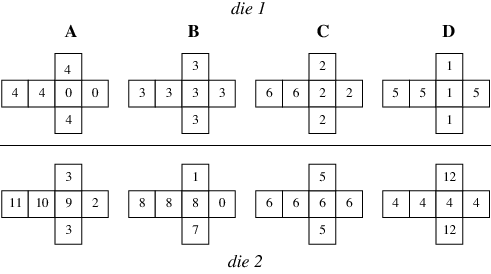
There are several ways in which numbers on nontransitive dice can be arranged. Here are two ways involving four dice:


Take a look at the upper deck of four dice. A will tend to beat B. Why? Because four out of six times die A will land the number 4 and two out of six times it will land on the number 0. However, die B will land 3 on every roll because all its six sides carry the number 3. So, two-thirds of the time A will beat B and one thirds of the time B will beat A.

Similar analysis shows that B will beat C two-thirds of the time and C will beat D two-thirds of the time. The nontransitive property of the dice, however, also means that D will beat A two-thirds of the time.

So the trick lies in making your opponent choose first. If she chooses A, you must choose D. If she chooses B, you must choose A. If she chooses C, you must choose B, and if she chooses D, you must choose C.

Similar analysis will work with the lower deck of dice.

The general lesson from the wager is that blind faith in "first mover advantage" is often misplaced. Sometimes, the odds of the business game are such, that it is advantageous for you to allow your opponents to make the first move and then decide your own move (including whether you want to move at all or not).

SUBSEQUENT CLARIFICATION FROM FUTILE FRANCE

Subsequent to my posting of the above blog post, Futile France wrote to me and clarified that Buffett-Gates wager involved four dice and not three.

I had relied on an old paper version of the HBR article (which mentioned three dice - I reconfirmed), whereas, Futile not only looked up his (corrected) electronic copy of the same article, he also checked out the Fortune article. He also gave two links which I'd like to share here:

http://tinyurl.com/7fmja
http://tinyurl.com/dluoh

Thanks Futile!

Saturday, November 05, 2005

One Valuation Rule, Two Paradoxes

In his book, Security Analysis, Benjamin Graham gives an elegant rule on valuation of equities which I call as the rule of minimum valuation. This rule states that:

"An equity share representing the entire business cannot be less safe and less valuable than a bond having a claim to only a part thereof."

The wisdom of the rule of minimum valuation arises out of the fact that it allows you to use elementary math to prove the cheapness of a stock. To see how, let me use the very example that Graham used in the 1934 edition of Security Analysis. It’s the example of the American Laundry Machinery.

American Laundry Machinery
In early 1933, the stock of this debt-free company was quoting at $7 per share. The company had 614,000 shares outstanding. The market cap came to $4.3 mil. Graham gave the following additional information about the company:

Cash assets: $ 4.13 mil
Other current assets: $ 17.4 mil
Current liabilities: $ 0.20 mil
Average 10 years earnings before interest: $ 3.15 mil
Average earnings per share: $ 5.13

At $7 per share, the stock of this company was selling for less than 2 times average earnings. Moreover the company classified as a net-current-asset bargain. So, it was a cheap stock. But Graham wanted to prove it mathematically. How did he do that?

Graham Plays a Mental Game
He played a mental game. He said that let us make this debt-free company issue 45,000 hypothetical bonds of $100 each and let us make this company distribute these hypothetical bonds to its shareholders without taking any cash from them. Since the hypothetical bonds were to carry an interest rate of 5% p.a., they would represent an annual interest expense of $ 225,000 to the company. This was not a problem at all since the company’s average annual earnings of $3.15 million were 14 times annual (hypothetical) interest. With such a healthy interest coverage ratio, the bonds deserved to be classified as high-grade bonds. Because market interest rates were slightly higher than the 5% interest which these bonds were paying, Graham valued these bonds at $94 each.

So, the total market value of the 45,000 bonds came to approximately $4.3 million, which, not co-incidentally, was the same as the market value of the entire company before it issued the bonds!

The interesting thing is that shareholders of American Laundry Machinery did not have to pay anything to receive the bonds distributed by the company. If you owned 1% of its equity shares, you'd automatically recieve 1% of its bonds. Moreover, the shareholders did not have to surrender their shares in exchange of the bonds. Even so, the insersion of a prior claim reduced the fair value of the equity shares of the company. However, since the market value of the bonds received was the same as the market value of all the shares in the un-leveraged American Laundry Machinery, the shareholders who receieved the bonds had no cause for complaint. They now simply held two pieces of paper – one representing ownership stake in the corporation and the other a claim against its assets and earning power. And the combined market value of two pieces of paper they now held in the leveraged American Laundry Machinery was bound to be significantly more than the market value of the shares in the unleveraged American Laundry Machinery they held earlier.

This process of creating and distributing bonds, which we now call as leveraged recapitalization, proved that the stock of the unleveraged American Laundry Machinery simply cannot be less than the value of the 45,000 bonds issued by the leveraged American Laundry Machinery. Graham explained:

“The purpose of this analysis is to show that at $7 per share for American Laundry Machinery stock in early 1933- equivalent to only $4,300,000 for the entire business- the purchaser was getting as much safety of principal as would be required of a good bond, and in addition he was obtaining all the profit opportunities attaching to common stock ownership.

Our contention is that if American Laundry Machinery had happened to have outstanding a $4,500,000 bond issue, this issue would have been considered adequately secured by the standards of fixed-value investment.

There would have been no question about the continuance of interest payments, in view of the powerful cash position revealed by balance sheet. Nor could the investor fail to be impressed by the fact that the net current assets alone were nearly five times the amount of the bond issue.

If a $4,500,000 bond issue of American Laundry Machinery would have been safe, then the purchase of the entire company for $4,300,000 would also have been safe. For a bondholder can enjoy no right or protection which the full owner of the business, without bonds ahead of him, does not also enjoy. Stated somewhat fancifully, the owner (stockholder) can write out his own bonds, if he pleases, and give them to himself.”

Debt Capacity Bargains
Over the last ten years, I have frequently used the rule of minimum valuation to identify stocks for further research that appear to be ridiculously cheap. I call this theme of deep value investing as debt capacity bargains. The process used to identify stocks using this theme, is derived from Graham’s rule of minimum value. It's a very simple process but it requires one to do a bit of backward thinking, which is Mr. Charlie Munger’s favorite thinking style (more on this thinking style in a future blog post).

Before I lay down the process of how I use the debt capacity bargains theme, let me restate the rule of minimum valuation, in Graham’s own words, this time, from his other book, The Intelligent Investor:

“There are instances where an equity share may be considered sound because it enjoys a margin of safety as large as that of a good bond. This will occur, for example, when a company has outstanding only equity shares that under depression conditions are selling for less than the amount of the bonds that could safely be issued against its property and earning power. In such instances the investor can obtain the margin of safety associated with a bond, plus all the chances of larger income and principal appreciation inherent in an equity share.”

Here is the process I use to identify stocks for further research which are cheap under my debt capacity bargains theme of deep value investing:

  1. Look for debt-free companies which have displayed stable earning power in the past and are expected to continue to do the same in the future as well;
  2. Average the past earning power (use cash flow from operations after deducting increase in working capital and maintenance capex).
  3. Use a desired interest coverage ratio of 3x to 5x, depending on the character of the industry – Use 3x for highly stable businesses, 5x for cyclical businesses;
  4. Using data from the above two steps, work backwards to estimate the amount of interest expense that can easily be serviced by the company;
  5. Divide the interest expense arrived at in step 4. into the current interest rate to determine debt-capacity of the company;
  6. Compare this debt-capacity with the current market cap, and if the market cap is less than debt-capacity, consider buying the stock.

An example would explain. Suppose that the past annual average cash flow from operations of a debt-free company after adjusting for working capital changes and maintenance capex is $100 million. Assuming that its business operations are fairly stable, by using the desired interest coverage ratio of 4x, we estimate that this company can easily afford to carry debt which would require payment of $25 million ($100 million/4) of interest payments every year. Given that the current rate of interest for such companies is 5% p.a., the company’s comfortable debt capacity comes to $500 million ($25 million/0.05). In other words, if this company had bonds in issue having a face value of $500 million, then these bonds would easily classify as high-grade bonds with little credit risk, worthy of investment-grade credit rating, and worthy of selling in the market at near $500 million value.

Now, if the market cap of this company is less than $500 million it means that the stock is selling for less than this debt-free company's debt-capacity – making it similar to Graham’s American Laundry Machinery. That is, if you buy the stock of this unleveraged company for less than a total value of $500 million, you’re, in effect, acquiring a high-grade bond having a market value of $500 million, plus you're getting equity stake for free. In other words, a free lunch!

Basically, by buying the stock at that ridiculously low price, you're exploing the deep truth in the rule of minimum valuation, which is that hidden inside every stock of a debt-free company is a high-grade bond which can easily be valued.

Paradox # 1: The Bond Fund Manager
This brings me to the first paradox which is:

A bond fund manager will refuse to buy shares of a debt-free company quoting at a price implying a market value of the company to be less than its debt-capacity and yet, he’d gladly buy the bonds of this very company created thru the process of a leveraged recapitalization.

This irrational behavior on the part of the fund manager would, to a very substantial degree, be due to the ignorance of the fundamental truth in the principle of minimum value. And even if the bond fund manager understood the principle, he’d rationalize his unwillingness to buy the stock and his willingness to buy the bond by stating that he is not allowed to buy stocks for his bond fund. And if he gave you that rationalization, he’d display his ignorance of Shakespeare’s famous quote from Romeo and Juliet:

“What’s in a name?
That which we call a rose by any other word would smell as sweet."

His third argument rationalizing his behavior could be that the act of buying bonds entitles him to receive contractual interest payments, but if he had bought the stock instead, he’d get a right to receive only discretionary dividends. This silliness of this argument is obvious from the fact that its not contractual rights, but the cash generating ability of a corporation which overwhelmingly determines its value and investment merit.

Paradox # 2: The Miracle of Financial Engineering
The second related paradox is this:

A banker will refuse to lend money to an uncreditworthy, speculative company (think “dotcoms”) whose stock may be selling at a ridiculously high price, but the same banker will gladly advance loans to the shareholders of that very company against the security of its highly liquid shares!

This “miracle” of financial engineering which makes the owners of a corporation creditworthy, even though the corporation is anything but, has its roots in: (1) the incorrect treatment of difference between the market price of the shares given as collateral and the loan advanced as genuine margin of safety; and (2) almost blind faith in liquidity of the stock market which will presumably allow the banker to offload the shares when needed (he forgets Keynes’ acute observation that “of the maxims of orthodox finance none, surely, is more anti-social than the fetish of liquidity, the doctrine that it is a positive virtue on the part of investment institutions to concentrate their resources upon the holding of "liquid" securities. It forgets that there is no such thing as liquidity of the investment for the community as a whole.”)

Mr. Charlie Munger knows this paradox very well. It was him, after all, who brought it to my attention a few years ago when dotcoms were the rage. At that time he had said:

“What’s fascinating . . .is that you could now have a business that might have been selling for $10 billion where the business itself could probably not have borrowed even $100 million. But the owners of that business, because its public, could borrow many billions of dollars on their little pieces of paper- because they had these market valuations. But as a private business, the company itself couldn’t borrow even 1/20th of what the individuals could borrow.”

This example of a "miracle" of financial engineering is by no means the only example. There are others but their discussion will have to wait for another day.

Let me end, though, by quoting Michael Aronstein, who, in the excellent book, Five Eminent Contrarians, pretty much agreed with my own views on the subject, by saying:

“Of the many advances in the long history of commerce, the advent of sausage stands out as one of the greatest. The idea of taking something which, in pure form, would be repellent to potential customers, and by thorough grinding, mixing, reshaping and adulterating, creating an entirely new entity that could be marketed free from the taint of its original ingredients, marked a milestone in the annals of business thought. . . Sausage making is the prototype for an entire class of merchandising technique that has become particularly common in modern finance . . . The financial marketer who uses commingling as an approach is responding to the same general conditions that drive the sausage stuffer: an abundance of lower grade ingredients along with hungry and credulous public.”

Tuesday, November 01, 2005

The Boiler Room Lollapalooza

How can a prosperous man take one phone call from someone he never met or even talked to before, and over the course of the next few minutes agree with the request of the caller to make a foolish “investment” in a company he never heard of before?

Obviously greed is a reason. Greed is associated with reward superresponse tendency which is a mental model from psychology. In this case, its the greed of the broker, induced by huge commissions, which drives his behaviour, and its the greed of the customer, whose desire to get rich quick, contributes to his mental malfunction.

But is greed the only reason which produced this outcome, or is there something else?

There has to be something else, isn’t it? Lollapalooza outcomes are never due to only one reason. It’s a combination of many mental models, all working in the same direction, which produce lollapalooza outcomes.

So which models combined to produce this lollapalooza outcome?

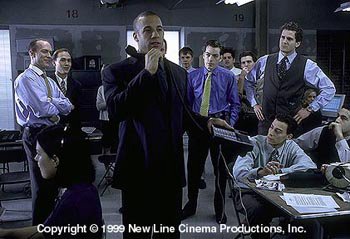
The above story was taken from the film Boiler Room, an awesome movie which I screened in my class recently to students who had earlier read Mr. Munger’s talks on psychology. Members of the audience enjoyed the film, I think, because they could easily relate the Munger mental models from the talks to the scenes in the film.

My favorite scene is a lollapalooza. In this scene, Seth (played by Giovanni Ribisi) is a broker dealer working for a boiler room operation under the name of J.T Marlin Associates. Seth and his mentor, Chris (played by Vin Diesel) talk to Dr. Jacobs (played by Peter Maloney) on the phone, and by the end of the conversation, which lasts just a few memorable minutes, they basically get him to foolishly hand over his hard-earned money to them.

How did Seth and Chris do it? I think it’s very interesting to see how the pair used several mental models from psychology in combination to achieve the desired outcome - for them, not for Dr. Jacobs (boiler room operations are zero-sum games, which, incidentally, is also a mental model with enormous applicability – more about that one in a future blog post.)

An excellent way to identify the mental models embedded in the scene is to read its script, which I am reproducing below, while having the Munger Mental Model Checklist from psychology in front of you.

This is the procedure I followed, and was amused, though not surprised, to find the presence of multiple models in Munger's checklist in that memorable scene.

Read the script of the scene below along with my comments[IN CAPITALISED BOLD LETTERS IN BRACKETS] and I think you'll arrive at the same conclusion as mine.


INT. BOILER ROOM - DAY

SETH (O.S.)
I'm sorry, sir, I didn't realize...

DR. JACOBS
I'm really busy, Seth.

Seth looks over towards Michael's office and sees Greg and three other team leaders coming out.

SETH
I understand. I'm real busy here myself, Doctor. Look, we're going to come back to you in a month with one idea and one idea only. If you like what we have to say, great, we'll do business. Worst case scenario you'll hear yourself a new business idea. Chat about it with your golfing buddies and we'll part as friends. That's fair, right? [ONE IDEA AND ONE IDEA ONLY - SETH INVOKES THE SCARCITY MODEL HERE]

A nurse is asking the Doctor a question and he loses focus.

DR. JACOBS
Ummm what?

SETH
Great. So tell me, Doc, are you working with a million dollars in the market right now?

DR. JACOBS
Who is this again?

SETH
Tell me something, you're a doctor. Have you ever heard of a drug called Fenamul? It's being manufactured by MSC pharmaceuticals. [INFLUENCE FROM MERE-ASSOCIATION TENDENCY I.E. ASSOCIATION OF DRUG WITH DOCTOR]

DR. JACOBS
No.

SETH
Well it's in the third stage of FDA approval right now. Word is, it's going to get approved in the next three months. Could be tomorrow for all I know. Anyway, I'm getting ahead of
myself. And you're real busy over there. Why don't I send you out the info you requested about the firm and a senior broker will call you next month with that one idea. [AUTHORITY MISINFLUENCE TENDENCY - FDA AS AUTHORITY HERE. ALSO SCARCITY - SCARCE, VALUABLE INSIDE INFORMATION PRESENTED EXCLUSIVELY]

DR. JACOBS
Wait, wait, wait, hold on a second, forget the info, let's talk about this now. What was the name of the drug again? [DEPRIVAL SUPERREACTION TENDENCY - DR JACOBS REACTS TO THE POTENTIAL LOSS OF AN OPPORTUNITY BY DISPENSING WITH THE NEED TO BE DILIGENT]

Seth begins to smile.

SETH
You know what, sir, let me pass you on to a senior broker who's more involved with this particular stock. Hold on a second. [AUTHORITY MISINFLUENCE TENDENCY - SENIOR BROKER AS AN AUTHORITY FIGURE WHO IS SUPPOSED TO KNOW MORE, HE WILL NOT SAY ANYTHING INCONSISTENT WITH WHAT THE JUNIOR BROKER SAID - THE WHOLE THING IS PART OF THE ELABORATE GAME DESIGNED TO GAIN THE CUSTOMER'S CONFIDENCE]

Seth pushes the hold button. He pauses and then YELLS:

Reco!!

Everything and everyone in the room stops. There is a slight
pause and then CHAOS. About 20 brokers BOLT toward Seth.

Chris is closest. Another broker JUMPS onto the table separating him from Seth and clambers over it. Chris puts on the steam and gets there first. The other broker runs straight into Seth, unable to stop.

Chris regains his composure wiping the smile off his face.

CHRIS
Card.

SETH
Okay, his name's Dr. Jacobs and from the sound of it, I'd say he's
definitely...

CHRIS
Whoa, whoa, I don't wanna hear it, kid.

Chris grabs the card from his hand and looks at it briefly.


CHRIS (CONT'D)
Hi, Dr. Jacobs, this is Chris Marlin over at JT Marlin.

DR. JACOBS
Marlin?

CHRIS
Right. He's my father.

Another broker connects a wire to a jack on the back of the phone and the conversation is now heard on the PA system.

CHRIS (CONT'D)
So my associate tells me you're interested in one of our stocks.

DR. JACOBS
Yes, MSC sounds like it might be interesting.

CHRIS
Might be? Might be doesn't sell stock at the rate MSC is going, Dr. Jacobs. We're talking about very high volume here. [SOCIAL PROOF TENDENCY - VERY HIGH VOLUME IMPLIES THAT THERE ARE MANY OTHERS WHO APPROVE OF THE IDEA WHICH AUTOMATICALLY MUST MEAN THAT IT'S A GOOD IDEA]

DR. JACOBS
Well, I still have to run it by my people.

CHRIS
That's great, Doc. If you want to miss yet another opportunity here and go watch your colleagues get rich doing clinical trials, then don't buy a share and hang up the phone. [DEPRIVAL SUPERREACTION TENDENCY, AND ENVY/JEALOUSY TENDENCY INVOKED TOGETHER IN JUST TWO SENTENCES RESULT IN TOTAL SUPRESSSION OF THE DESIRE TO QUESTION ANYTHING]

DR. JACOBS
Well hold on a second. I didn't say that. I just wanted to talk more about it.

CHRIS
Honestly Doc, I don't have the time. This stock is blowing up right now. The whole firm is going nuts. Let me open the door to my office.

Chris holds the phone up to the 100 brokers standing there silently. They begin talking loudly and screaming "Buy, Sell". Chris makes a hand motion and they stop.

You hear that? That's my trading floor, Doc. Now I have a million calls to make to other doctors who are already in the know. I can't walk you through this right now. I'm sorry.

Huge pause. Everyone looks on waiting to hear what he'll do. Chris doesn't even look mildly concerned. Then... [DEPRIVAL SUPERREACTION TENDENCY I.E. TIME IS RUNNING OUT DR JACOBS + SOCIAL PROOF TENDENCY I.E. JUST HEAR HOW PEOPLE ARE NUTS OVER THIS STOCK + ENVY I.E. OTHER DOCTORS ARE GOING TO GET RICHER = BUY NOW! IT HAS TO WORK NOW ISN'T IT?]

DR. JACOBS
Okay, okay. Let's do this. [MISSION ACCOMPLISHED! - THEY GOT HIM - HOOK, LINE, AND SINKER]

CHRIS
Now, since you're a new account I cannot go any higher than two thousand shares. I'd love to but I just can't do it. [AVAILABILITY MISINFLUENCE TENDENCY - CHRIS VERY CLEVERLY NOW MENTIONS A FIGURE OF 2,000 SHARES WHICH IS PROBABLY MORE THAN WHAT DR. JACOBS WOULD HAVE BOUGHT - HE CREATES AN AVAILABLE ANCHOR IN THE MIND OF DR. JACOBS - ANCHORING BIAS AS A SPECIAL CASE OF AVAILABILITY BIAS COMBINES WITH DEPRIVAL SUPERREACATION TENDENCY]

DR. JACOBS
Two thousand?! Whoa! That's way more than I was thinking about. Two
thousand, Jesus. (pause)

I'm just curious, why can't you sell me more than that? [THE STRATEGY IS WORKING! DEPRIVAL SUPER-REACTION TENDENCY COMBINES WITH REWARD SUPERRESPONSE TENDENCY TO MAKE DR. JACOBS TO WANT MORE SHARES!]

The brokers hold in their laughter.

CHRIS
Well, we like to establish a relationship with our clients on something small before we get to the more serious trades. Let me show you several percentage points on this small trade and then we'll talk about doing future business.

DR. JACOBS
That sounds good. Give me two thousand shares.

CHRIS
Done.

DR. JACOBS
You sure you can't do any better on this one?

CHRIS
No, I'm sorry, Dr. Jacobs.

DR. JACOBS
Alright, let's start with this trade then.

CHRIS
Great. I promise we'll go big on the next one.

Now do you want the confirmation sent to your office or your mansion?

DR. JACOBS
(laughs)
Very funny, Mr. Marlin.

CHRIS
Alright, let me put my secretary on. She'll take your info.

Chris hits the hold button and then...

CHRIS (CONT'D)
Done and done.

The entire firm applauds when he gets off the phone. The crowd disperses. Chris sits down on Seth's desk.

CHRIS (CONT'D)
I love doctors, man. All that money and not a clue what to do with it. Fucking rollovers. Hold onto your ankles, Doc, here comes the love.

SETH
Why'd you put a max on his buy?

CHRIS
Didn't you tell him how it works?

GREG
He's still a trainee. He doesn't need to know about initial sell limits.

CHRIS
Right, right. Make sure he shows you the ropes. He's too busy calling his bookie. You fucking Hebrews, man. Always looking out for yourselves, never the trainees.

GREG
That's great. Why don't you go back to little Italy now?

Greg points across the room.

CHRIS
Why don't you go make a latke dreidel boy.
(back to Seth)
The reason I capped him is in case he's a piker. See, we're going to go ahead and front the money for this sale. If he doesn't send the check, I'm the one holding the bag.
(whispers)
Last commission month a kid on Jim's team wrote a million dollar ticket.
Stock was down three and a half points by settlement. Fucking kid took a one quarter million dollar hit. Besides, first sale just whets the appetite. If he's a whale, which it looks like he
is, then I'll get him on a day when there's a real rip.

SETH
Rip?

CHRIS
(surprised)
Rip. Commission. That's why we work here. We get huge rips. [REWARD SUPERRESPONSE TENDENCY- INCENTIVES AS SUPERPOWERS - GIVEN SUFFICIENT INCENTIVES AND YOU CAN BE VIRTUALLY SURE THAT THE PRODUCT/SERVICE WILL GET PUSHED TO THE CUSTOMER, NO MATTER HOW TOXIC IT MAY BE ]

SETH
(quietly)
I actually still don't know how it works.

CHRIS
A two dollar rip, which is unheard of anywhere on Wall Street, means you're walking away with two dollars for every share you sell. Real money. Jesus Greg, you tell him where the bathroom is yet?

GREG
Seth, I showed you where Chris' desk is.

SETH
How does Michael afford that?

CHRIS
I don't know, but if he's doing it, he's making money on it. Point is, don't worry about selling small on the first trade. You service the client right and he'll be back for more. Bide your time. Show him a three percent return and he'll trust you to watch his kids for the weekend. If he's serviced correctly it's not a matter of whether he's making a second trade with you, it's a matter of how much.

Chris' secretary calls out from across the room.

CHRIS
Gotta bounce.

Seth stands there in awe. He sees the potential here.

Sunday, October 09, 2005

Creative Whack Pack Teaches Charlie Munger's Way of Thinking

My favorite creativity tool is the Creative Whack Pack written by Roger Von Oech.

This pack of cards was designed by Oech to enable its users to practice creative thinking, which, in my view, is one extremely useful ingredient of investment success.

I recommend the purchase and extensive use of the Creative Whack Pack. For less than $11, it’s a great investment.

Given below are the brief contents of a few cards I selected from the pack, along with their connections with Mr. Munger’s way of thinking:

Card # 2 (“Ask Why?”) states:

“Leonardo Da Vinci “I roamed the countryside searching for answers to things I did not understand. Why shells exist on the top of mountains along with imprints of plants usually found in the sea . . . Questions like these engaged my thought throughout my life.””
[Connection with curiosity and the need to ask why? why ? why?]

Card # 3 (“Get Out Of Your Box”) states:

“Each culture has its own way of looking at the world. Often the best ideas come from cutting across disciplinary boundaries and looking into other fields . . ."
[Connection with multidisciplinary thinking]

Card # 15 (“Let Your Mind Wander”) states:

“Much of our thinking is associative. One idea makes you think of another - no matter how logical the connections. Use this ability to generate new ideas . . .”
[Connection with Pavlovian Association]

Card # 27 (“Reverse”) states:

“Reversing how you look at a situation can open up new possibilities and dislodge assumptions . . .”
[Connection with backward thinking (Jacobi's "Invert, always invert"), and first conclusion bias]

Card # 25 (“Combine Ideas”) states:

“The time has come, the Walrus said, “to talk of many things – of shoes and ships – and sealing wax – and of cabbages – and kings. Combining unusual ideas is at the heart of creative thinking."
[Connection with Munger framework of mental models]

Card # 42 (“Beware the Unintended”) states:

“In preparing for the Olympics, the coach of a leading new team invited a meditation instructor to teach awareness techniques to his crew. He hoped that such training would enhance their rowing effectiveness. As the crew learnt more about meditation, they became more synchronized, there was less resistance, and their strokes got smoother. The irony is that they went slower. It turned out that the crew became more interested in being in harmony than winning.”
[Connection with “effects have effects”]

Card # 45 (“Don’t Fall in Love with Ideas”) states:

“If you fall in love with an idea, you won’t see the merits of alternative approaches and will probably miss an opportunity or two. One of life’s great pleasures is the letting go of a previously cherished idea. Then you’re free to look for new ones”.
[Connection with the need to look for disconfirming evidence, first conclusion bias, and bias from commitment and consistency]

Card # 63 (“Learn from Mistakes”) states:

“On his way to creating the light bulb, Edison discovered 1,800 ways not to make one. One of Madam Curie’s failures was radium. Columbus was looking for India. Errors are one of life’s primary learning vehicles. That’s because success reinforces the way you do things. When you fail however, you learn what’s not working, and you get the opportunity to try new approaches.”
[Connection with the need to examine one’s own mistakes as well as those of others, and learning from them].

Feeds for this Blog

Got this idea from Shai's blog.

http://feeds.feedburner.com/blogspot/yRcA

http://fundooprofessor.blogspot.com/atom.xml

Thanks Shai!

Saturday, October 08, 2005

Lollapalooza from Insider Trading

Once upon a time, a friend of mine knew someone, who knew someone in a big, listed company. And through this chain, he got reliable, price sensitive, inside information about the company.

The information was this: In two weeks, there would be an announcement about the settlement of a major legal dispute in which the company was involved. The settlement was going to be hugely in favor of the company.

The sums involved were large and my friend estimated that when the news becomes public information, the stock should soar by a minimum of 150%. His computations were conservative.

And so, my friend concluded that this was a once in a lifetime opportunity to become richer than he already was. This was his chance to be free.

He decided to back up the truck. He quickly liquidated his entire stock portfolio, worth a substantial sum, and all his other assets, and used the entire proceeds to buy his favorite stock. And then, he borrowed more money and trebled his position in the stock.

And in a matter of two weeks, he went bust. And he went bust despite the inside information he was betting so heavily on, being correct.

What happened?

This is what happened: Just before the announcement my friend was betting on, a massive earthquake hit the only plant of the company and completely destroyed it and its associated future earning power. The stock fell 40% despite the announcement of the positive news. The market ignored the positive news my friend had bet everything on and focused on the new development instead.

The banks, who had lent money to my friend, asked him to put up more money or securities in his account. But he didn’t have any more money or securities. All of his wealth was in this one stock. And so, the bank liquidated his stock in a fire sale, and he lost every penny he had earned and saved. He went bankrupt. The irony, of course, is that he was right about the information, but he still went bust. Now, that's a lollapalooza.

What created this lollapalooza outcome?

This is a very interesting question.

Lollapalooza outcomes do not happen for just one reason. There has to be a combination of several mental models, all working in the same direction, which produces lollapalooza outcomes.

Which mental models combined to produce this horrible outcome for my friend? There were four:

  1. Tendency to overweigh scarcity;
  2. Excessive self-regard tendency;
  3. Over-optimism; and
  4. Availability-misweighing tendency.

Of these four tendencies, the first one is described very well in Robert Cialdini’s great book, Influence. The other three tendencies were described by Mr. Charlie Munger in his essay titled “The Psychology of Human Misjudgment” included in his biography.

Under the scarcity principle, we tend to overvalue something that is scarce. The tendency that makes us rush and buy things we do not need in discount sales that will end in a few hours is the same tendency that makes us put a high value on useless information when it is put under censorship. The very same tendency makes investment opportunities available to us seem more valuable when they are not available to others.

My friend had access to privileged, and valuable, information. This automatically led him to over-weigh the value of the information in his possession.

In his essay, Mr. Munger talked about excessive self-regard tendency leading to what he called as the “endowment effect”. Man has an automatic tendency to over-weigh something in his possession. That includes himself, his family members and friends, and his material possessions. If you suffer from this tendency, then if you own something, you’ll value it more highly than you would have, if you did not own it. If asked to sell it, you’d tend to ask for a substantially higher price than its true worth. This tendency makes someone, who has bought a stock, even more bullish about it than before, immediately after he bought it.

My friend suffered from the endowment effect. Not only the information was valuable because it was scarce, the endowment effect made it even more valuable to him immediately after he possessed it. And that, of course, led to over-optimism which led him to bet everything he had (and more through borrowed money) on one stock.

There is one more tendency which contributed towards my friend's gamble. This is the availability-misweighing tendency. To quote Mr. Munger:

“Man’s imperfect, limited-capacity brain easily drifts into working with what’s easily available to it. And the brain can’t use what it can’t remember or when it’s blocked from recognizing because it is heavily influenced by one or more psychological tendencies bearing strongly on it. . .”

In my poor friend’s situation, the tendency to overweigh scarcity and excessive self-regard tendency combined to produce over-optimism tendency, and the combined power of these three tendencies made him totally blind as to the possibility of some event that could make his excessive investment in the company, wrong.

The availability heuristic is the source of one of the most common biases we all suffer from– the availability bias. As Tversky and Kahneman explained in 1973, we assess the frequency, probability, or likely causes of an event by the degree to which instances or occurrences of that event are readily “available” in memory.

And, of course, if something is not available in our memory, we simply cannot assign a weight to it so we leave it out of our decision-making process, leading us to make bad judgment calls, like in my friend’s case.

My friend forgot to ask the simple question: “Despite my possession of this wonderful, and scarce, information, are there factors that could possibly make my decision a bad one?” He did not seek evidence that disconfirmed his much-loved notion. And that, in my view, destroyed him.

If he has asked this simple question, he would have come to the correct conclusion that Mr. Munger gave in his essay: “An idea or a fact is not worth more merely because it’s more available to you.”

So, that's how these four psychological tendencies combined together and impaired the cognition of my friend, thereby ensuring that he lives miserably ever after. . .

Friday, September 30, 2005

Explaining Mr. Munger's "Kantian Fairness Tendency"

Arpan Ranka, a student at MDI, recently asked me to explain Mr. Charlie Munger's mental model titled "Kantian Fairness Tendency". This model was mentioned by Mr. Munger in the revised version of his essay titled "The Psychology of Human Misjudgment". This essay is one of several essays contained in "Poor Charlie's Almanac".

I believe Mr. Munger was referring to man's overlove of fairness for all, often resulting in bad outcomes for humanity. Earlier, he had made a reference to this subject in his UCSB talk in which he said:

"It is not always recognized that, to function best, morality should sometimes appear unfair, like most worldly outcomes. The craving for perfect fairness causes a lot of terrible problems in system function. Some systems should be made deliberately unfair to individuals because they’ll be fairer on average for all of us. I frequently cite the example of having your career over, in the Navy, if your ship goes aground, even if it wasn’t your fault. I say the lack of justice for the one guy that wasn’t at fault is way more than made up by a greater justice for everybody when every captain of a ship always sweats blood to make sure the ship doesn’t go aground. Tolerating a little unfairness to some to get a greater fairness for all is a model I recommend to all of you. But again, I wouldn’t put it in your assigned college work if you want to be graded well, particularly in a modern law school wherein there is usually an over-love of fairness-seeking process."

I see a connection between the above quote and the "law of the higher good" which I discovered in Machiavelli's "The Prince". Last year, I had written a note on the law of the higher good to my students. Here's a revised version of that note:

Machiavelli's "The Prince" is a great book and should be made compulsory reading for all MBA students.

To many people, The Prince is an evil book. But Joseph L. Badaracco, who teaches a hugely popular course titled "The Moral Leader" at the Harvard Business School uses this book to teach ethics. And he teaches ethics by telling students to follow Machiavelli's advice in The Prince. In an interview, Badaracco has said that four different takes on The Prince usually emerge in classroom discussions of The Prince at HBS:

Version 1 : "This book is a mess. It was written by a guy who hoped to get to the center of things, was there briefly, offended some of the wrong Medicis, was exiled, was tortured, and wanted to get back in." It’s "a scholar’s dream because you can find anything you want in it and play intellectual games. But just put it aside."

Version 2 : "Now wait a minute. There’s some good common sense in there. Machiavelli is basically saying that if you want to make an omelet you have to break some eggs... To do some right things, you may have to not do some other right things."

Version 3 : Other students believe the book is still around because it’s so evil. Why is it evil? "If you look closely at The Prince," he said, "it’s quite interesting what isn’t in the book. Nothing about religion. Nothing about the Church. Nothing about God. There’s nothing about spirituality. Almost nothing about the law. Almost nothing about traditions. You’re out there on your own doing what works for you in terms of naked ambition."

Version 4 : "A fourth Prince that other students uncover is the most interesting one, in Badaracco’s mind. Students find that the book reveals a kind of worldview, he says, and it’s not an evil worldview. This version goes: "If you’re going to make progress in the world you’ve got to have a clear sense, a realistic sense, an unsentimental sense, of how things really work: the mixed motives that compel some people and the high motives that compel some others. And the low motives that unfortunately captivate other people." Students who claim the fourth Prince, Badaracco said, believe that if they're going to make a difference, it’s got to be in this world, "and not in some ideal world that you would really like to live in."

One of my favourite mental models comes from The Prince. I call this model, the "law of the higher good". Before I read The Prince, I read an excellent book called, "The Contrarian Guide to Leadership" by Steven Sample. In this book, which was recommended by Mr. Munger, Sample's thoughts on the law of the higher good from The Prince resonated very well with what Mr. Munger has been advocating for years. I reproduce here an extract from Sample's book which deals with the law of the higher good:

"Let me clarify the most fundamental misunderstanding. Machiavelli was not an immoral or even an amoral man; as mentioned earlier, he had a strong set of moral principles. But he was driven by the notion of a higher good: an orderly state in which citizens can move about at will, conduct business, safeguard their families and possessions, and be free of foreign intervention or domination. Anything which could harm this higher good, Machiavelli argued, must be opposed vigorously and ruthlessly. Failure to do so out of either weakness or kindness was condemned by Machiavelli as being contrary to the interests of the state, just as it would be contrary to the interests of a patient for his surgeon to refuse to perform a needed operation out of fear that doing so would inflict pain on the patient."

The law of the higher good is a terribly useful model for leaders because it forces them to think about things from a totally different perspective. Here's a hypothetical situation to ponder about:

You are in charge of running a retail store and one of your cashiers, an elderly woman, is caught committing a minor embezzlement. Fearing that she might be dismissed, she approaches you to plead forgiveness. She tells you that this is the first time she embezzled money from the company and promises that she'll never do it again. She tells you about her sad situation, namely that her husband is very ill and that she was going to use the money to buy medicines for him. She becomes extremely emotional and your heart is melting. What do you do?

Something similar to the above situation was described by Mr. Munger in a talk given by him. He used two models to produce his answer. The first model was probability. Mr. Munger implores you to reduce the problem to the mathematics of Fermat/Pascal by asking the question: How likely is it that the old woman's statement, "I've never done it before, I'll never do it again" is true?

Note that this question has nothing whatsoever to do with the circumstances in this particular instance of embezzlement. Rather, Munger is relying on his knowledge of the theory of probability. He asks: "If you found 10 embezzlements in a year, how many of them are likely to be first offences?"

The possible actions are: (1) She is lying and you fire her (good outcome - because it cures the problem and sends the right signals); (2) She is telling the truth and you fire her (bad outcome for her but good outcome for system integrity); (3) She is lying and you pardon her (bad outcome for system integrity); and (4) She is telling the truth and you pardon her (bad outcome for system integrity because it will send the wrong signal that its ok to embezzle once).

Weighed with probabilities, and after considering signaling effects of your actions on other people's incentives and its effect on system integrity, its clear that the woman should be fired.

Looked this way, this is not a legal problem or an ethical problem. Its an arithmetical problem with a simple solution. This extreme reductionism of practical problems to a fundamental discipline (in this case mathematics), is, of course, the hallmark of the Munger way of thinking and living.

So, from a leader's perspective, it's more important to have the right systems with the right incentives in place, rather than trying to be fair to one person - even if that person is the leader or someone close to the leader.

The logic is that leaders must look at such situations from their civilization's point of view rather than the viewpoint of an individual. If we create systems which encourage embezzlements, or tolerate such systems, we'll ruin our civilization. If we don't punish the woman, the idea that its ok to do minor embezzlement once in a while, will spread because of incentive effects, and social proof (everyone's doing it so its ok). And we cannot let that idea spread because that will ruin our civilization. Its that simple.

Saturday, September 10, 2005

A New Blog Takes Shape

My colleagues and I have started a new blog for Tactica Capital Management, our company.

This blog will focus on my professional side. Over time, we would put up for sharing with the world, some of the investment ideas that worked out very well for us, and the reasoning behind those ideas [Process more important than outcome].

We will also talk about our investment mistakes (yes we have them) and sort of rub our noses in them.

Sanjay Bakshi

Friday, September 09, 2005

Carol Loomis, Risk, and the Law of Conservation of Energy

Carol Loomis is a legend. Her columns in Fortune are a collector's item and I have been a collector since 1994 – the year in which I started out my career in investments.

In March 1994, Loomis wrote an article on derivatives in Fortune titled "The Risk that Won't Go Away". I was totally blown away after I read that article. At that time, derivatives were the talk of the town. There was an explosion in the usage of derivatives, particularly, non-traded ones, which ostensibly enabled companies to “manage risk” at a low cost.

Loomis however took the opposite view and predicted trouble ahead. And sure enough, trouble followed soon after, when several derivatives-related financial fiascos like those at Bankers Trust, Gibson Greetings, Orange County, and P&G emerged. These were covered by Loomis a year later in March 1995 in a column titled "Untangling the Derivatives Mess" which essentially said “I told you so”.

What is the connection between the law of conservation of energy and the concept of risk in financial markets?

In my view, there’s a big connection. I feel that they are essentially the same – an insight I got after reading the above Loomis’ columns although she herself did not talk about the connection.

The law of conservation of energy states that the total inflow of energy into a system must equal the total outflow of energy from the system, plus the change in the energy contained within the system. In other words, energy can be converted from one form to another, but it cannot be created or destroyed.

Simply change “energy” for “risk” and you’ll have the law of conservation of risk.

The law of conservation of risk states that the total inflow of risk in a system must equal the total outflow of risk from the system, plus the change in the risk contained within the system. In other words, risk can be converted from one form to another, but it cannot be created or destroyed.

Take the simple example of a hedging operation involving shorting index futures. The hedger who shorts the index futures is trying to protect herself from a market decline. Should the market decline, the value of her stock portfolio will also decline, but this decline is expected to be offset by the profit she will make on the short futures position. So far, so good. But, is it?

Is it really that simple? Has the risk to the hedger been reduced? Of course not. The risk of the decline in the price has merely been transferred to the buyer (counter-party) of the index futures. But that’s not the whole story. There is more to it.

By selling the index futures, the hedger has transferred the price risk to the buyer of the index futures but has assumed another risk. That risk is credit risk i.e. the risk that the counter-party may default.

While it’s true that with the presence of organized futures markets with margin requirements and other risk mitigation measures in place, credit risk is much lower at the individual level, this does not mean that the risk in the entire system has been reduced. At the individual level, risk may be reduced but not at the system level.

Risk can be sliced and diced. Risk can be transferred from one person to another. And one form of risk might replace another form, but at the end of the day, the total risk in the system is not going to change.

In other words, just like energy, risk can be converted from one form to another, but it cannot be created or destroyed.

And that’s one insight that has paid me well over the last eleven years…

Monday, September 05, 2005

Jared Diamond's "Dam Fools"

Jared Diamond is one hell of a thinker. I really like the way he thinks. The ideas described by him in his talks and in his wonderful books are also portable i.e. their lessons can be applied in other fields like investments.

His book, "Guns, Germs, and Steel: The Fates of Human Societies" contains highly useful ideas about how to think correctly. It's no wonder that Mr. Charlie Munger has been recommending Diamond's book for years. Diamond's way of thinking is highly multidisciplinary, which I think, is exactly what Mr. Munger likes about him.

I've yet to start reading Diamond's other famous book, "Collapse: How Societies Choose to Fail or Succeed". However, a couple of days ago, I started watching the recently released DVD on Guns, Germs, and Steel. If you do not have the time or the inclination to read the book, watch the DVD.

You will also enjoy reading the transcripts of two of Diamond's talks from here and here.

The earlier of these two talks titled "How to Get Rich?" beautifully illustrates the role of competition in wealth creation rather than wealth destruction. This talk also wonderfully explains how innovation really works.

The second talk titled "Why Do Some Societies Make Disastrous Decisions?" could actually have easily been titled "Why Do Some Investors Make Disastrous Decisions?" In this talk, I loved Diamond's discussion of "Psychological Denial" one of the several mental models from psychology used by Mr. Munger. Here's a wonderful quote on psychological denial from that talk:

"Consider a narrow deep river valley below a high dam, such that if the dam burst, the resulting flood of water would drown people for a long distance downstream. When attitude pollsters ask people downstream of the dam how concerned they are about the dam's bursting, it's not surprising that fear of a dam burst is lowest far downstream, and increases among residents increasingly close to the dam.

Surprisingly, though, when one gets within a few miles of the dam, where fear of the dam's breaking is highest, as you then get closer to the dam the concern falls off to zero! That is, the people living immediately under the dam who are certain to be drowned in a dam burst profess unconcern. That is because of psychological denial: the only way of preserving one's sanity while living immediately under the high dam is to deny the finite possibility that it could burst."

How can the idea of psychology denial as explained by Diamond be applied to another field like investments? Diamond's example of what I call "dam fools" has a close parallel to what happens to most investors, the media, and the politicians at the peak of an asset price bubble. The most recent example was that of the dotcom bubble where most people were victims of sheer psychological denial. They were blissfully ignorant of the trouble ahead.

Another application of psychological denial which I have observed is when I meet with, or read the interviews of, the managements of some companies. For example, Steel executives were bullish when prices were at their peak. Why does this happen? I think part of the reason why it happens is that people are too close to the scene of the action, just like the "dam fools" in Diamond's example.

I think one the traits one needs to learn is the ability to "zoom out" and look at the big picture which is not easy when you are too close to the scene of the action.

Yet another example of psychological denial is seen when management is over-confident of its own abilities and under-confident of the abilities of its competition. Recently, I met with the management of a profitable Indian company which manufactures a commodity product at a low cost. However, a much bigger competitor is creating new capacity in China. If this new capacity comes on stream, it can destroy the profitability of the most of the players in the industry. The management of the company I met, however, feels that the Chinese player will not be able to stabilise the plant. When I come across such responses from managements, the "Dam Fool" example of Diamond pops up in my mind!

Why would a fellow who is spending hundreds of millions of dollars to build capacity in a growing industry not be able to stabilise a plant? Sure, it would cost money to poach some of the smartest engineers and technicians, but for a person who has already made that large size commitment, the incremental cost required to get the right people to get the job done will be really small, isn’t it? [Commitment and Consistency - Psychology, Contrast Effect - Psychology]

It's such a simple question, but the management of the Indian company would not like to ask it. Now that's psychological denial. So, psychological denial operates at a subconsious level in the minds of investors as well as company managers.

A marvelous example of psychological denial at both levels was depicted in the movie "Other People's Money". In this fantastic film, which I recommend watching, "Larry the Liquidator", played by the giant of American cinema, Danny DeVito, is trying to convince the shareholders of New England Wire & Cable Company to vote him into power so that he can liquidate the company because in his view it deserves to be liquidated. You can hear the speech of the incumbent manager, Andrew Jorgenson, played by Gregory Peck, from here and that of DeVito from here.

Here's a quote from DeVito's speech which beautifully illustrates psychological denial, both at the corporate as well as the investor level:

"This company is dead. I didn't kill it. Don't blame me. It was dead when I got here. It's too late for prayers. For even if the prayers were answered, and a miracle occurred, and the yen did this, and the dollar did that, and the infrastructure did the other thing, we would still be dead. You know why? Fiber optics. New technologies. Obsolescence. We're dead alright. We're just not broke.

And you know the surest way to go broke? Keep getting an increasing share of a shrinking market. Down the tubes. Slow but sure. You know, at one time there must've been dozens of companies makin' buggy whips. And I'll bet the last company around was the one that made the best goddamn buggy whip you ever saw. Now how would you have liked to have been a stockholder in that company? You invested in a business and this business is dead. Let's have the intelligence, let's have the decency to sign the death certificate, collect the insurance, and invest in something with a future."

Sunday, September 04, 2005

Revisiting Oxford Book Club Talk Given in July 2002

In July 2002, I was invited to give a talk on value investing at the famous Oxford Bookstore in Mumbai. The talk was attended by about forty fund managers and analysts.

Today, I found that presentation on my computer and was reading it. I was fascinated to find how well some of the stocks that I had spoken about in 2002 have performed since then.

Gesco Corporation has gone from Rs 11 in June 2000 to Rs 204 now. Trent has gone from Rs 60 in August 2001 to Rs 875. Gujarat Mineral Development Corporation has gone from Rs 45 in January 2002 to Rs 436 now. Zodiac Clothing has gone from Rs 43 in October 2001 to Rs 535 now. Blue Star Infotech has gone from Rs 35 in August 2001 to Rs 150 now. SRF has gone from Rs 26 in July 2002 to Rs 314 now (excluding the value of shares of a company spun off from SRF). Hindustan Motors has gone from Rs 9 in July 2002 to Rs 46 now. And Himatsingka Seide has gone from Rs 97 in July 2002 to Rs 556 now. All of these stocks have outperformed the market handsomely.

The only disappointment has been Regency Ceramics which has not gone anywhere in the last four years.

All of the above stocks were identified using very simple hueristics derived from Graham's philosophy of deep value investing.